Looking for Language and Finding History
How language functions as a system of identity, conflict, and inherited history.

When Learning a Language Becomes Something Else
I began studying French for my master’s program, expecting to focus on grammar charts and vocabulary drills. I did not expect to feel like I was assembling a map. The deeper I went, the clearer it became that languages are not neutral tools. They are systems — structured reflections of power, contact, conflict, migration, and memory.
As I added new French phrases to my mind, something surprising happened. They started interacting with the languages I’m familiar with: English, Cameroonian Pidgin, Nigerian Pidgin, and Ghanaian Pidgin. The connections weren’t linguistic coincidences. They were historical footprints.
It felt less like learning a language and more like tracing history in reverse.
The History “Palava” as a Case Study
I had a conversation with my father. While speaking, I used the Pidgin word “Palava,” a casual term for “trouble” that floats across West Africa. My father paused and told me a part of its story I had never heard. During his research trip to Ghana, he visited Cape Coast Castle. Deep in the brick labyrinth is a cramped holding room where enslaved Africans were kept before being shipped away.
That space was commonly referred to as the palava room. The room was tiny, sometimes no wider than ten or fifteen feet, yet inland capture networks would drop off dozens of people at once while waiting for European ship captains to arrive. There was no air circulation, no privacy, no way to distinguish yourself from the strangers pressed against you. The word itself predates the transatlantic slave trade; it already existed as a term for dispute, entanglement, or complication. What the room did was give the word a new reference point. It became associated with a very specific kind of “trouble”: forced capture, forced waiting, forced proximity.
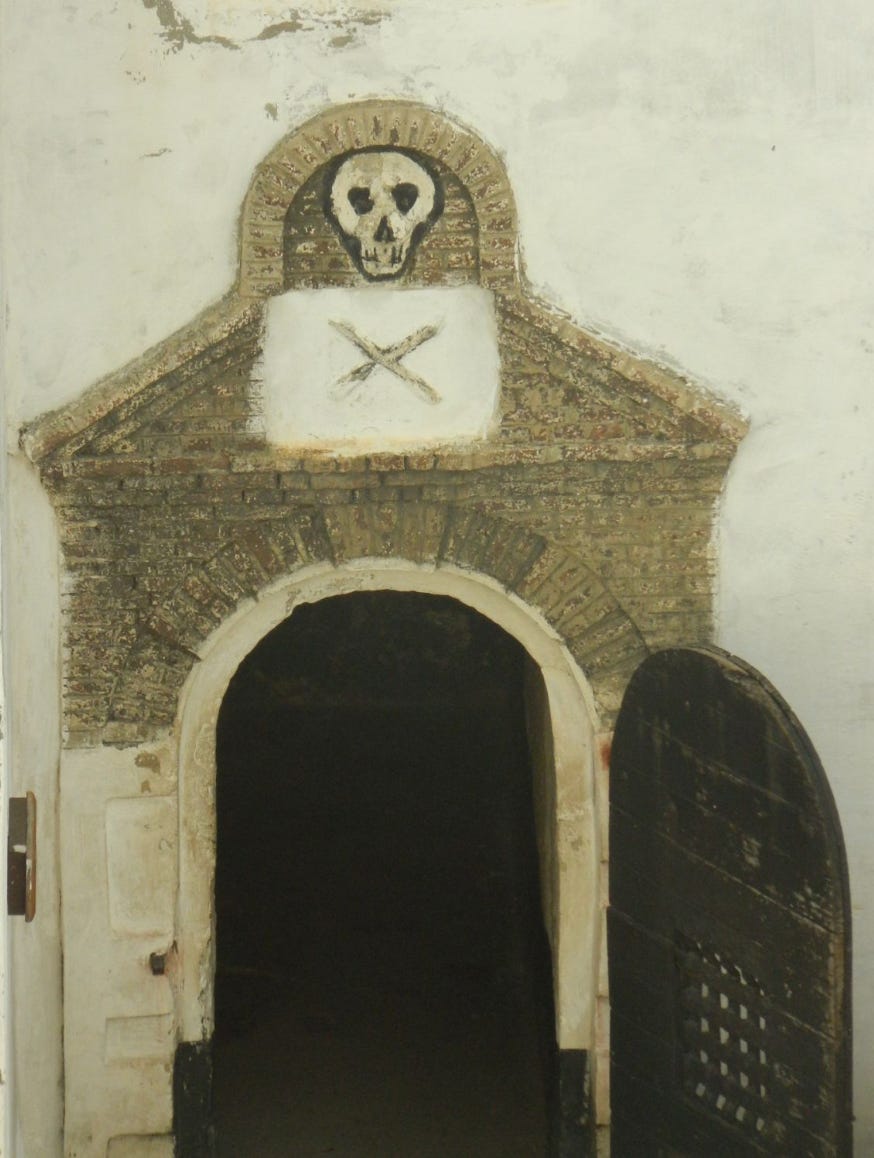
Language often does this. It absorbs new meanings when history presses itself against daily speech. Linguistic research even shows that grammatical patterns and word meanings can persist through extreme social upheaval, including displacement and trauma.
“Creole languages are hybridized languages. They’re often born of harsh social conditions and upheaval, such as colonial slaveries, when disparate groups of people are forced quickly forge ways of communicating.”
From that period, the term continued to travel through coastal towns, across ship decks, into new regions, and back again. As people adapted, survived, rebuilt, and re-rooted, the word evolved with them.
For me, this story is a reminder that language doesn’t simply describe reality. It archives it to a specific time and place. Words outlive the events that shaped them. They retain traces of memory, even when the people speaking them no longer know the history they’re invoking.
Languages Are Systems
When I began studying French, I expected the usual struggle: verbs, articles, nasal vowels that still refuse to cooperate. Yet as time passed, I noticed how languages overlapped, diverged, and borrowed from one another. Every phase contains a piece of history: colonization, resistance, adaptation, and cross-border kinship.
Linguistic scholarship supports this. Studies of contact languages, including Pidgin and Creole language structures, show that Pidgins and Creoles encode layered histories of contact between African, European, and Indigenous languages. They preserve not only vocabulary but also grammatical structures that reveal trade routes, power asymmetries, and moments of cultural fusion.
Last month, I became obsessed with a UK YouTube channel called NDL. They have a series where the hosts try to identify a guest’s language, country, accent, etc. The premise is simple: a guest either speaks their native language, presents themselves, or brings an object representing their country, and the hosts must figure out the origin without any prior information. After the guest speaks, the hosts are allowed one single question. They use that question strategically, often to trap the guest into a specific region.
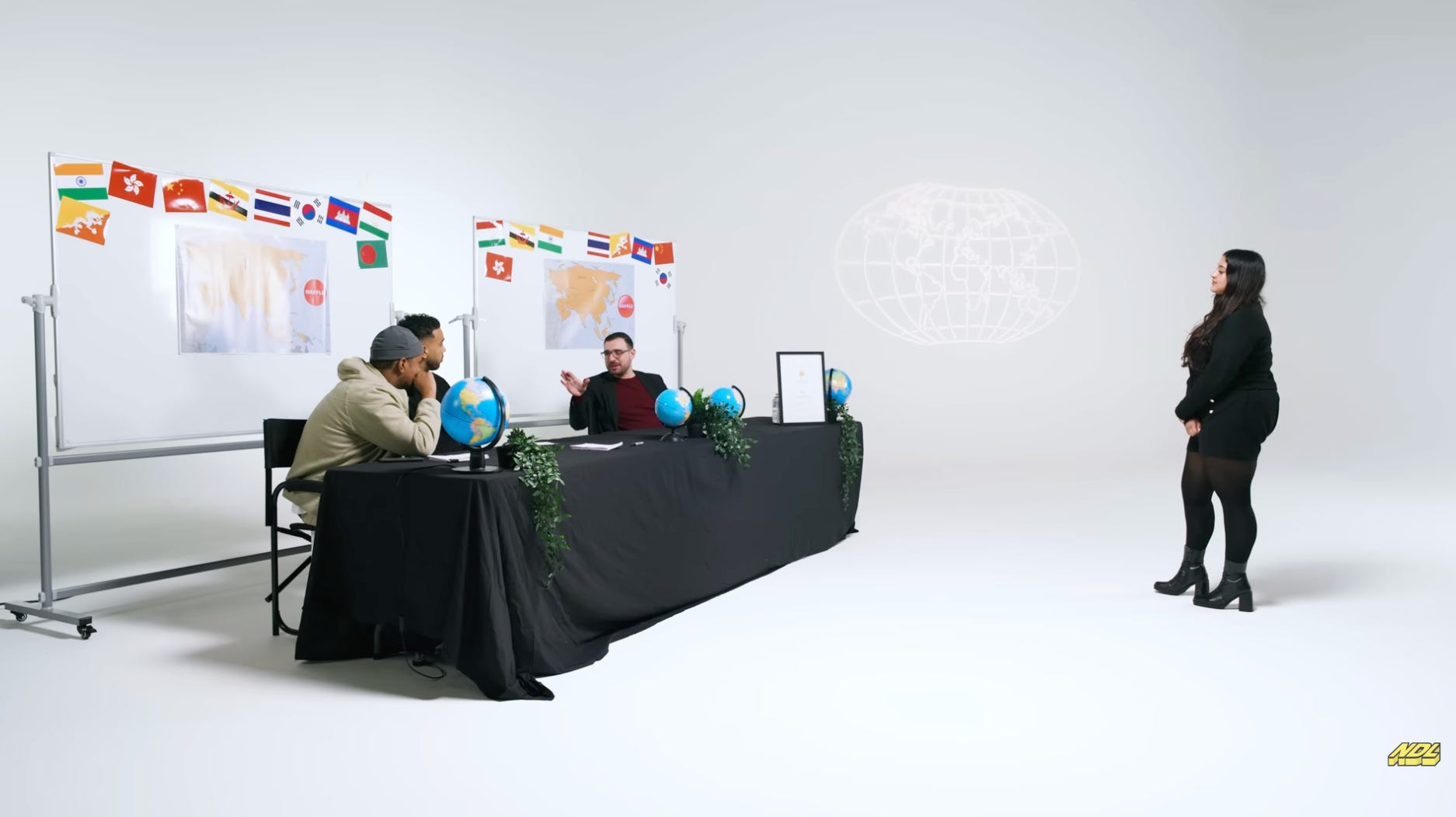
They ask things like, “Does your capital start with an A?” or “Does your country have this particular wedding tradition?”, to eliminate entire continents or narrow down a linguistic family tree in seconds.
What makes the show even more compelling is the competitive element. The hosts compete against a trained language expert. And sometimes — to the surprise of everyone watching — the expert loses. Academic knowledge of language does not always outperform intuitive pattern recognition. Sometimes the ability to hear subtle historical residue inside a word, or to reverse-untangle a migration pattern, beats textbook expertise.
What drew me in wasn’t the entertainment. It was the method. They looked for loanwords, phonetic histories, cultural traces, colonial fingerprints, and physical attributes. Observing other people treat language like a puzzle mirrored what I was already experiencing. It affirmed that what I felt intuitively — that languages carry embedded histories.
Seeing Language as a Time Machine
Now, I can’t unsee the layers. Every language I spoke revealed an architecture beneath it:
French carries the imprint of colonial governance in Cameroon.
Pidgin carries the pulse of cross-border cooperation, trade, and shared struggle.
English carries the posture of empire — its confidence, its reach, its insistence.
Each one feels like an artifact that reveals who touched whom, who ruled whom, who resisted whom, and who blended with whom.
Language is a time machine transporting us back and forth between histories that shape our identity.
The Systems Brain Awakens
Once I began examining the mechanics of language, its larger system became easier to see. Individual words functioned like nodes connected to histories, movements, and exchanges. Familiar phrases revealed their lineage and exposed the layers of contact and experience that allowed them to exist.
My mind naturally organizes into maps and charts — blank at first, then filling itself in with pathways indexed by meaning, impact, proximity, and context. Languages began lighting up the canvas.
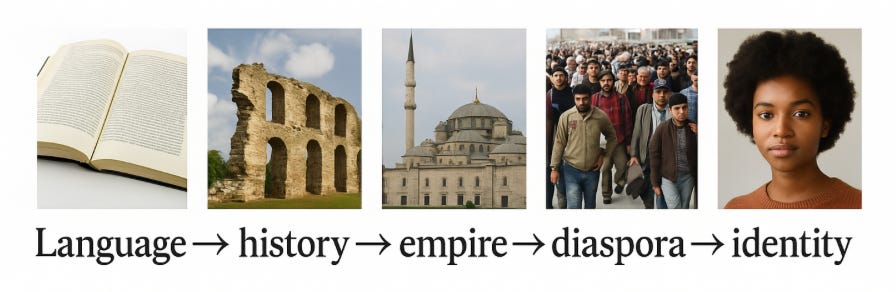
A chain you can follow in either direction.
Language reveals the history that shaped it. History exposes the structures of empire that organized people and resources. The Empire created the conditions that produced diasporas across continents. The Diaspora shaped how communities understand themselves and how identity is formed.
The movement also works in reverse. If you begin with identity, you can trace it back to the diasporic paths that shaped it. Those paths lead back to imperial structures and the histories that produced them. And those histories are preserved inside language itself.
This is why studying language feels like moving through an entire system rather than a single discipline.
Listening for What History Left Behind
Now, when I study French or hear a familiar Pidgin phrase, I pay closer attention to what sits underneath the sound. I ask where the word came from, who used it before me, and what movements or pressures shaped it. That habit has shifted how I listen in general. It trained me to notice the systems inside ordinary things.
This is something anyone can practice. Be curious about why things were named the way they were. Names often freeze an object, a place, or an experience in time, yet we move past them so quickly that we lose the opportunity to trace the history embedded in them. When you encounter a word that feels familiar, ask where it traveled from. When you use a phrase without thinking, consider why it exists at all. When you hear an accent, pay attention to the histories and exchanges that might sit inside it. None of this requires fluency. It simply requires curiosity.
In the field of historical linguistics, naming is considered a “temporal anchor.” A 2017 study in the Journal of Onomastics found that place names and object names can remain unchanged for 500–2,000 years, even if the community forgets why.
Learning languages has become, for me, less about mastery and more about awareness. It is a way of understanding how culture is formed, how memory is carried, and how identity is shaped across generations. Paying attention to language has taught me that history is not distant.
If there is anything to take from this, it is that language offers a practical entry point into systems thinking. It gives you a way to trace connections you might have otherwise missed and to understand your place in a much wider story.